

Today we will be examining what makes Leap day so special. Leap day is an extra day added to our Calendars. Thanks to Leap day we have Superman! Thanks to Leap Day we have Heqet the Goddess. We also have a Love for Frogs thanks to the day. So, Sit back and read on, as we dive into the fascinating reality that is Leap Day!
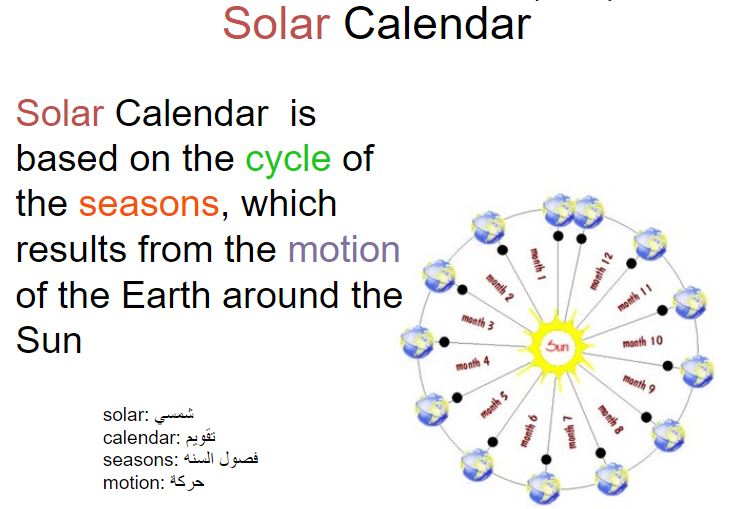
The point of leap years is to help adjust our Gregorian calendar (aka, the 365-day calendar you can find on your desk or phone) to the solar calendar (A solar calendar is a calendar whose dates indicate the season or almost equivalently the apparent position of the Sun relative to the stars. The Gregorian calendar, widely accepted as standard in the world, is an example of a solar calendar.) , and make sure we celebrate solar events like the spring and autumn equinoxes with some regularity every year. Even adding an extra day to February every four years doesn’t quite do the trick, which is why scientists sometimes call for a Leap Second like they did in 2015 on June 30th at 11:59:60 pm. (Readers Digest) Put simply, these additional 24 hours are built into the calendar to ensure that it stays in line with the Earth’s movement around the Sun. While the modern calendar contains 365 days, the actual time it takes for Earth to orbit its star is slightly longer—roughly 365.2421 days. The difference might seem negligible, but over decades and centuries that missing quarter of a day per year can add up. To ensure consistency with the true astronomical year, it is necessary to periodically add in an extra day to make up the lost time and get the calendar back in synch with the heavens. (History) https://www.history.com/news/why-do-we-have-leap-year
How do you remember if it’s a leap year?
Simple: If the last two digits of the year are divisible by four (e.g. 2016, 2020, 2024…) then it’s a leap year. Century years are the exception to this rule. They must be divisible by 400 to be leap years—so, 2000 and 2400 are leap years, but 2100 will not be one. As a bonus, U.S. leap years almost always coincide with election years. (Readers Digest) https://www.rd.com/culture/february-29th-leap-year-facts/

People born on Leap Day are called ‘Leaplings’ They are also known as Leapsters or Leapers. There are only about 5 million people in the whole world who were born on February 29, with the odds of being born on Leap Day standing at about 1-in-1,461. Leaplings technically only get to celebrate their birthdays once every four years, but they do get to be part of an elite group. (History)
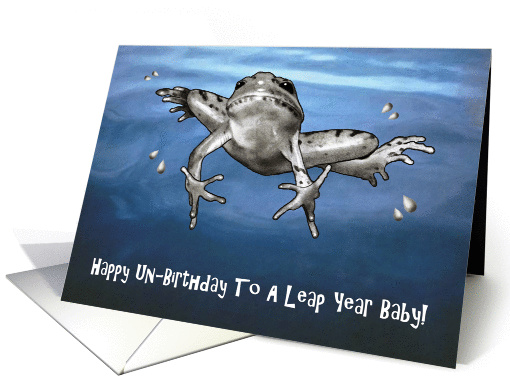
To buy this card, click this link. https://www.greetingcarduniverse.com/leap-year-birthday-birthday-cards/other/happy-birthday-leap-year-baby-1019881
Their ‘legal’ birthday on non-Leap Years varies
They’ve all heard the jokes about their age — that someone turning 28 is celebrating his seventh birthday — and every Leapling has grappled with whether to have a party on February 28 or March 1 on those non-Leap Years.
But what does the law say?
Well, it varies from country to country — and even among US states.
- Most countries and territories tend to recognize that a Leap Day baby has legally ‘aged’ on March 1 of non-Leap Years, including England, Wales, Hong Kong.
- Most of the US follows this, too. According to Reuters, only some states have statues that say which date should be used. For those that don’t, the default is March 1. For those that do, it is typically to signify that it is February 28.
- New Zealand also uses February 28, as does Taiwan.
There is a club for Leaplings that’s 10,000 members strong
Leaplings can find each other by joining the Honor Society of Leap Year Day Babies. Founded in 1997, it’s currently over 10,000 members strong. On Facebook, they have over 800 members. (Daily Mail) https://www.dailymail.co.uk/femail/article-5451921/10-things-didnt-know-Leap-Day-babies.html

Super birthday! Superman was said to be born on February 29

To learn how we know his birthday, please click the link https://www.cbr.com/superman-birthday-leap-day-february/
You may be working for free on leap day

Full-time employees with a fixed annual salary who work on February 29 may actually be working for free. An annual salary is technically set for a typical year, which doesn’t include the extra day every four years. This is not an issue when people are paid by the hour.
There is a Leap Capital of the world
Leap year has a hometown and it’s Anthony, Texas, which is on the border with New Mexico. Every leap year it hosts the Worldwide Leap Year Festival, which features parades and hot-air balloon rides. (WashFM) https://washfm.iheart.com/featured/toby-and-chilli-mornings/content/2020-02-28-surprising-facts-about-february-29th/

Anthony, New Mexico/Texas has held the title since 1988, when two women, Mary Ann Brown and Birdie Lewis, both born on February 29, asked the town’s Chamber of Commerce to host a giant birthday party for everyone born on a leap day, along with a festival honoring the leap year in general. Brown and Lewis said the Chamber that the celebrations would promote the small farming community.

So who designated frogs the unofficial official mascot of the leap year?
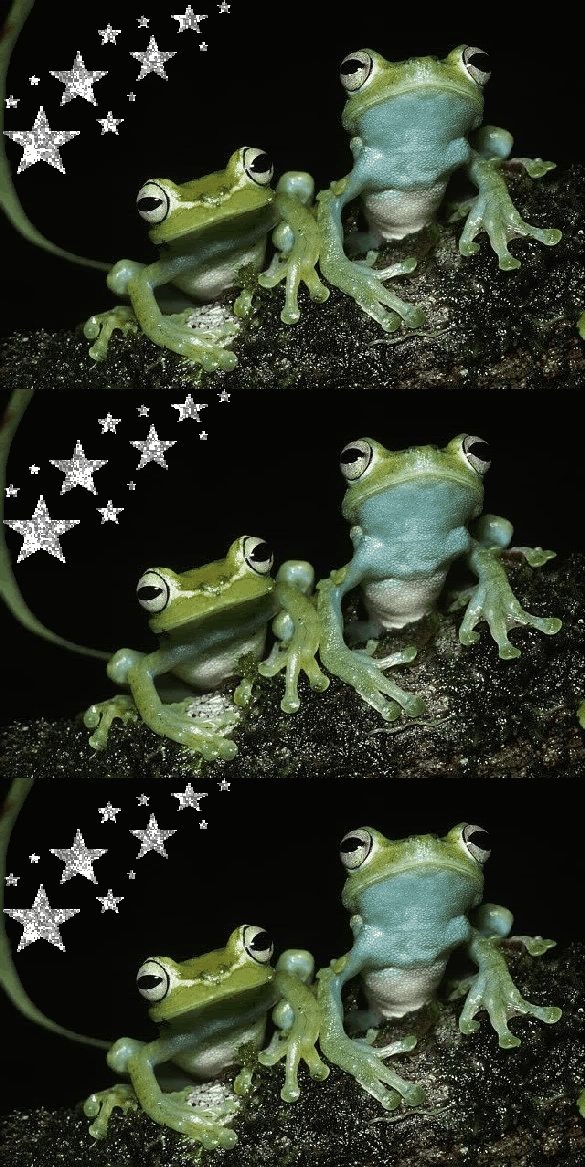
I couldn’t find an answer to that question, but regardless of which animal or insect would be your choice for the leap year mascot, I still go with the frog. Why? Perhaps it is because leap means “to jump or spring a long way, to a great height, or with great force.”1 But why frogs? Bunnies, kangaroos, grasshoppers, and sturgeon also leap. So do some spiders! Well, Mother Nature and evolution have granted frogs some fantastical traits and abilities.
Awesome Facts About Frogs
- There are over 4,700 species of frogs! They are found on every continent except Antarctica.
- Every year that a frog goes into hibernation, a new layer of bone forms. You can count these rings to find out the frog’s age.
- Many frogs can jump 20 times their own height. Some can jump even higher!
- Frogs come in all sorts of colors. The colorful skin of many tropical frogs acts as a warning to predators that these frogs are poisonous.
- The study of amphibians and reptiles is called Herpetology, and those who study them are called Herpetologists. The name comes from the Greek word Herpeton which means “something that crawls”.
- One of the ways you can tell a male frog from a female is by looking at their ears. A frog’s ear is called tympanum and it is located just behind the eye. If the tympanum is larger than the frog’s eye, it is male; if it is smaller, it is female.
- Did you know that frogs moult? This is the process where they shed their skin. Most frogs moult once a week but some will do it every day! Once the old skin has been pulled off, the frog usually eats it!
- Croaking is used by male frogs as a way to attract females. Each frog species has a distinct croak. They have vocal sacs, which fill with air, and can amplify the sound up to a mile away!
- Frogs have teeth on their upper jaw, which they use to keep their prey in one place until they can swallow it. Frogs swallow using their eyes; its eyes retract into its head and help push the food down its throat.
- Frogs don’t drink water with their mouths; they “drink” by absorbing water through their skin. Frogs have permeable skin, which means liquids and gases can pass through it. There is a bad side to having permeable skin, though. Frogs are at risk of absorbing whatever pollutions are in the water and air, and they can easily get dehydrated if they are away from water for too long. (Earth Rangers) https://www.earthrangers.com/top-10/top-ten-awesome-facts-about-frogs/
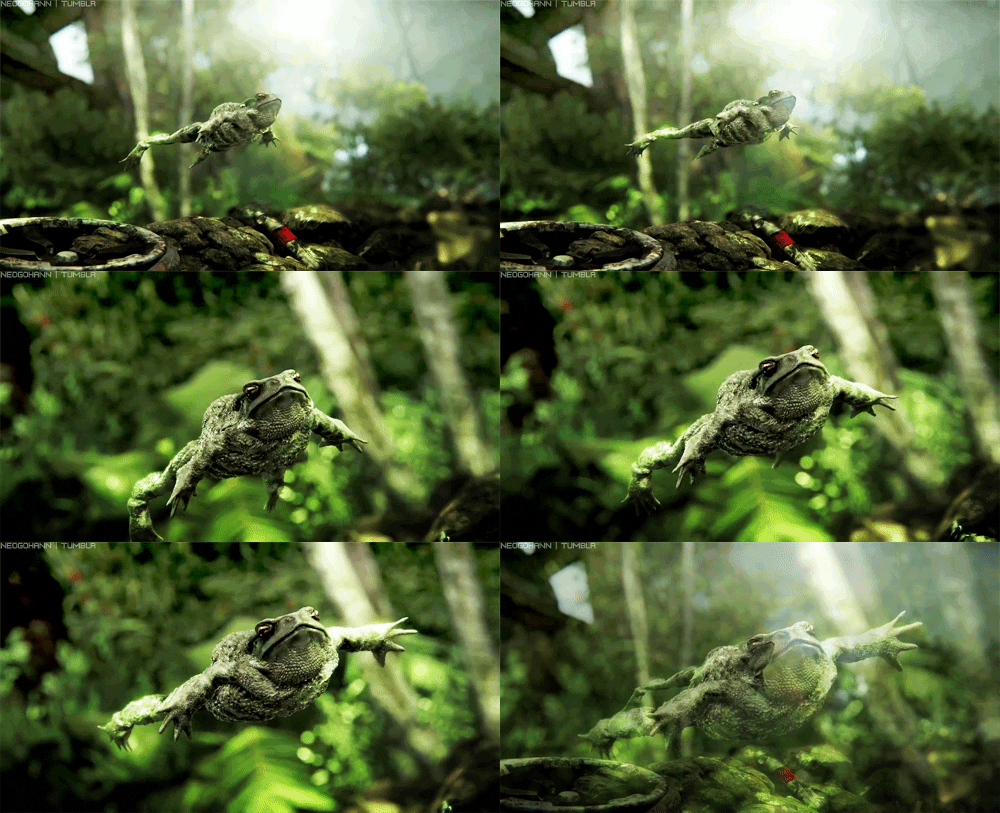
When a frog swallows its prey, it blinks, which pushes its eyeballs down on top of the mouth to help push the food down its throat. (Smithsonian)
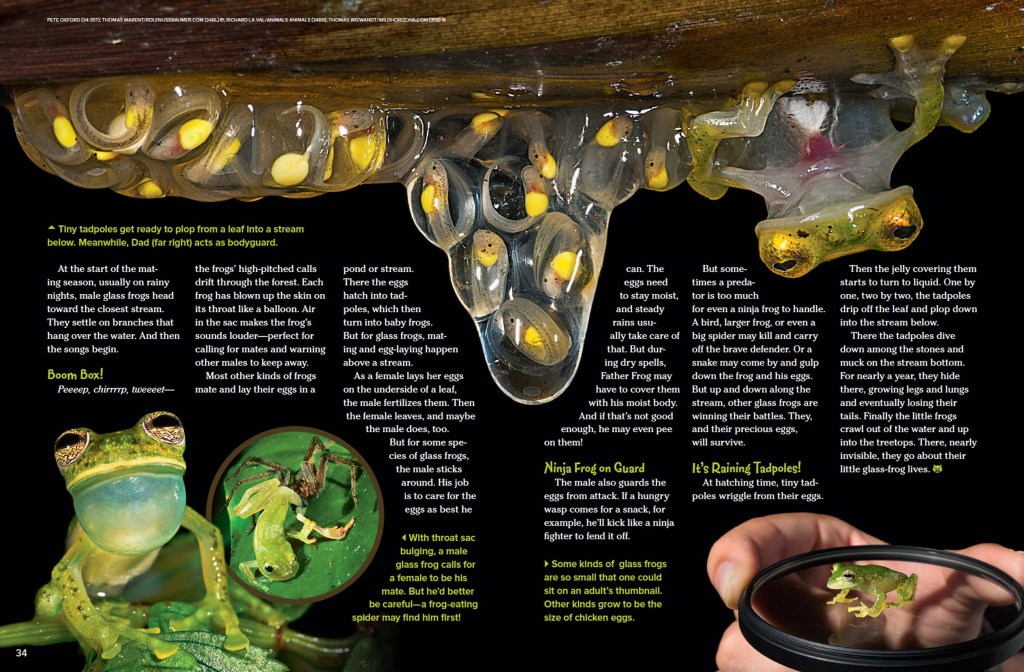
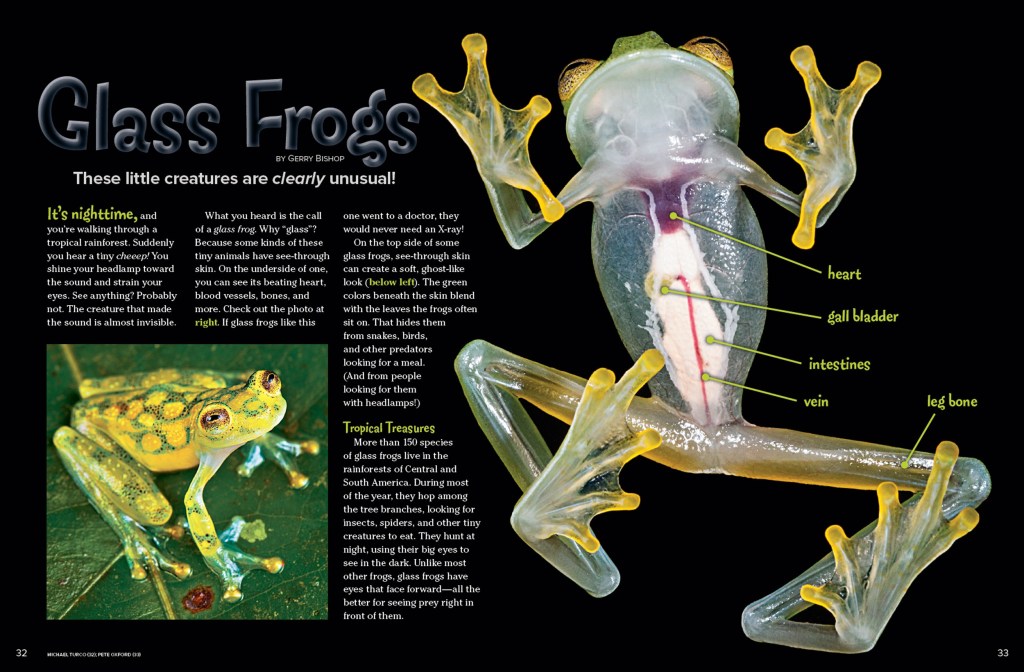
The above pictures were taken from the August 2015 issue of Ranger Rick magazine. To read the article on the glass frog, click the link. https://rangerrick.org/ranger_rick/glass-frogs/
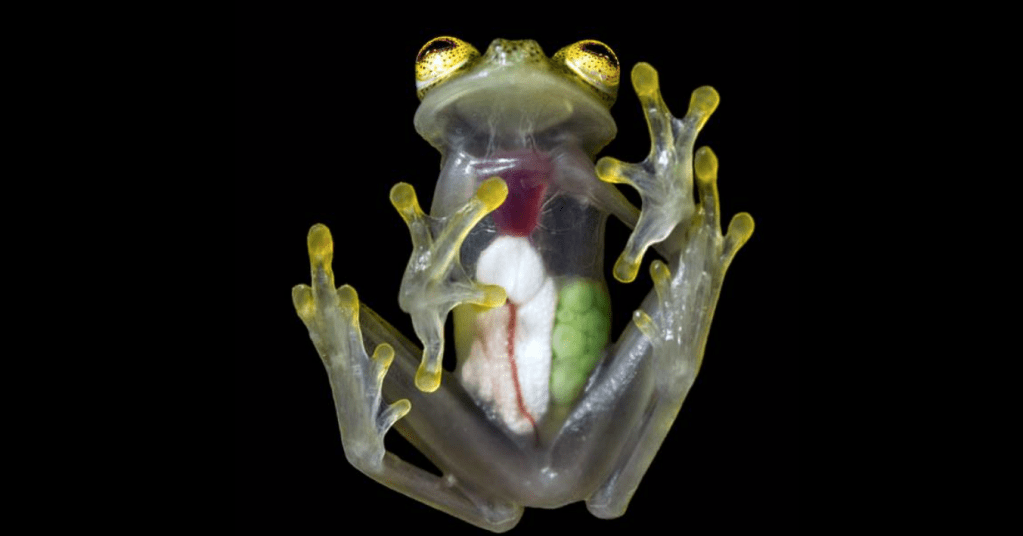
The glass frog has translucent skin, so you can see its internal organs, bones and muscles through its skin. You can even observe its heart beating and its stomach digesting food. (Smithsonian) To learn more about the Glass frog, click this link. https://www.rainforest-alliance.org/species/northern-glass-frog
World’s biggest frog
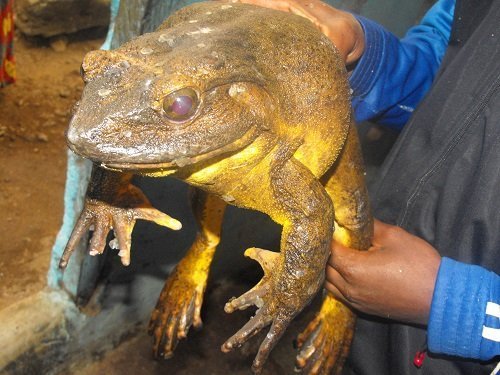
The biggest frog in the world is the Goliath frog. It lives in West Africa and can measure more than a foot in length and weigh more than 7 pounds – as much as a newborn baby. (Smithsonian) to learn more about the Goliath frog, please click the link. https://animals.sandiegozoo.org/animals/goliath-frog
One gram of the toxin produced by the skin of the golden poison dart frog could kill 100,000 people.
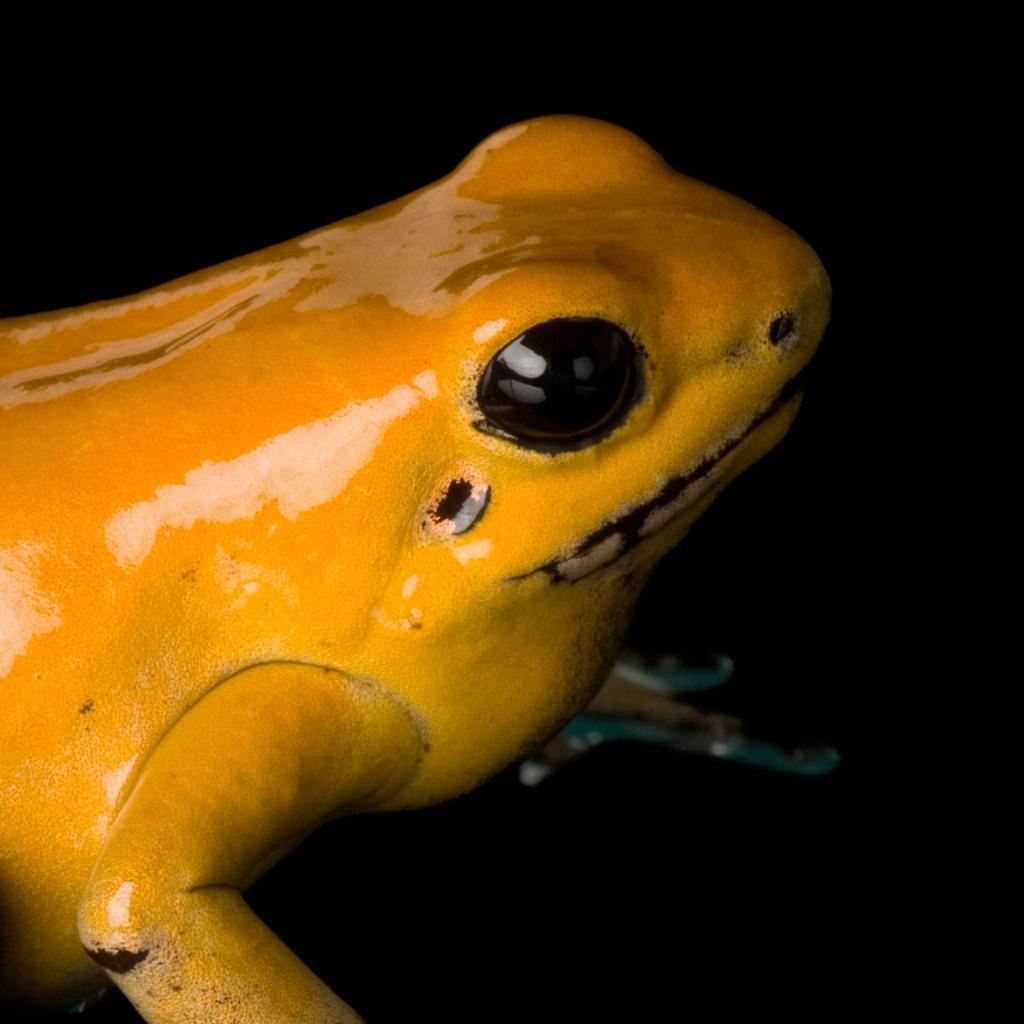
To learn more about the Golden Poison Dart Frog please click the link. https://www.nationalgeographic.com/animals/amphibians/g/golden-poison-frog/

The female Surinam toad lays up to 100 eggs, which are then distributed over her back. Her skin swells around the eggs until they become embedded in a honeycomb-like structure. After 12 to 20 weeks, fully formed young toads emerge by pushing out through the membrane covering the toad’s back.
To learn more about Surinam toads please click the link. https://animals.sandiegozoo.org/animals/surinam-toad

In 1834, Charles Darwin discovered a strange animal during his exploration of Chile’s southern coast. The creature, a small frog, was shaped like a leaf with a pointed nose, but appeared puffed up as if had been blown full of air, like a balloon. As it turned out, those fat male frogs hadn’t been gorging themselves on too many mosquitoes, but instead were enacting duties that earn them distinction as one of nature’s best dads. They were incubating several of their squirming babies in their vocal sac. These peculiar animals, known as Darwin’s frogs, are today divided into two species, one that occurs in northern Chile, and another that lives in southern Chile and Argentina. When a female Darwin’s frogs lay her eggs, her mate keep a careful watch until the tadpoles hatch. The eager dad then swallows his young, allowing the babies to safely grow within his vocal sac until they turn into frogs and are ready to strike out on their own. (Smithsonian) https://www.smithsonianmag.com/science-nature/one-of-natures-most-extreme-dads-the-darwins-frog-is-going-extinct-180947796/
To learn more about Darwin’s frog, click this link. http://www.edgeofexistence.org/species/northern-darwins-frog/

Frogs and Egypt
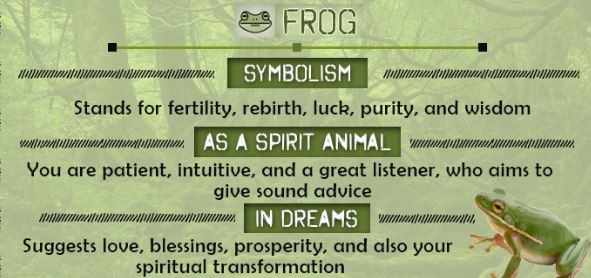
In Egypt the frog is the symbol of life and fertility, and in Egyptian mythology Heget is a frog-goddess who represents fertility.
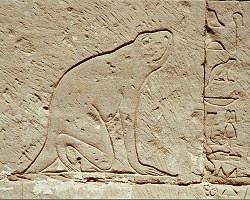
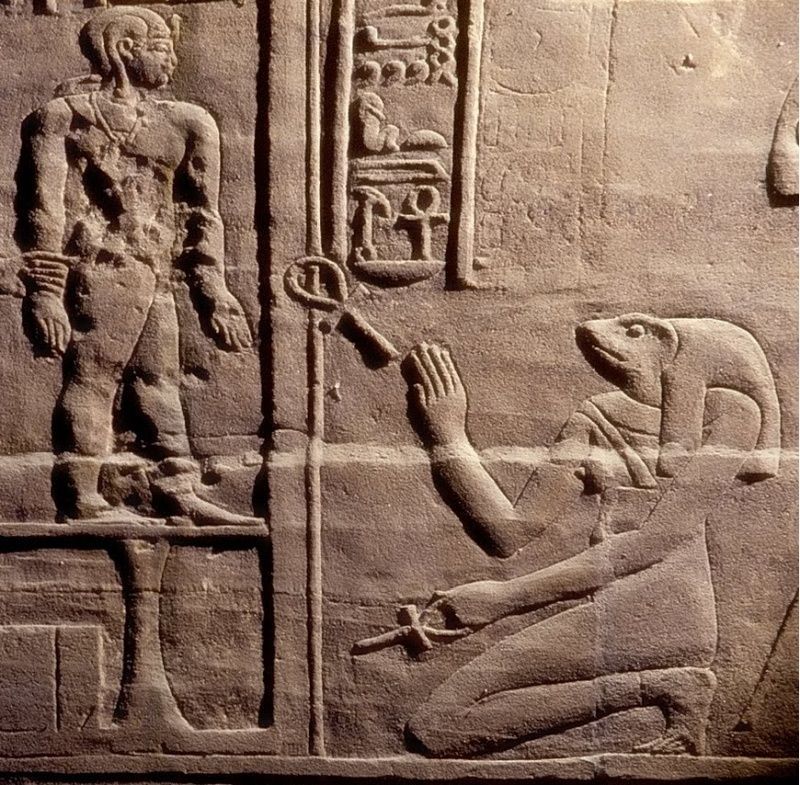
Heqet (Heqat, Heket) was a goddess of childbirth and fertility in Ancient Egypt. She was depicted as a frog, or a woman with the head of a frog. The meaning of her name is not certain, but possibly derived from the word “heqa” meaning “ruler” or “sceptre”. Frogs symbolised fruitfulness and new life, and it is thought that the her priestesses were trained midwives.

Pregnant women wore amulets depicting Heqet for protection, and during the Middle Kingdom ritual ivory knives and clappers inscribed with her name were used to ward off evil during childbirth. She could also bring on labour and offer protection during labour. Heqet assisted in this manner in the deliverance of three fifth dynasty kings, according to a myth recorded in the Westcar papyrus in the Story of the birth of the three pharaohs which appears at the end of the tale of “Khufu and the Magicians”.
She was also involved in the resurrection of the deceased. In the pyramid texts she assists the pharaoh as he makes his way to the eternal stars sky and is depicted beneath the funeral beir of the deceased Osiris in Denderah. There was a Ptolemaic temple to Heqet at Qus, but only one pylon remains. There is also a reference to a temple at Her-wer in a tomb at Tuna el-Gebel, but so far this temple has not been found. (Ancient Egypt online UK) https://ancientegyptonline.co.uk/heqet/

Thanks for hanging around me with today! I hope to see you here again real soon. If this post has interested you, please feel free to leave a comment. If you have cruised my other posts and found that you like them, please feel free to Subscribe. As always, feel free to share this post and all my posts to your pages and with your Family/Friends.

 Angelika's World