

Welcome back Friends! Today we will be taking Virtual trips to; Zoo’s, Aquariums, and Gardens. We will also be learning about some of the Animals we will see on these tours. We will begin with the Zoo’s.

Atlanta Zoo

Atlanta Zoo: This Georgia institution has a dedicated panda cam sure to put a smile on kids’ — and grown-ups’ — faces.

Panda

The panda, with its distinctive black and white coat, is adored by the world and considered a national treasure in China. (World Wildlife Federation) https://www.worldwildlife.org/species/giant-panda
13 Interesting Facts About Giant Pandas
- A giant panda is much bigger than your teddy bear. An adult panda weight more than 45 kilos (100 pounds) and can be about 1.5 meters (5 feet) long!
- Giant pandas are good at climbing trees and can also swim.
- Pandas go from pink to white and black (or brown). Pandas are born looking like baby badgers — fur-less, pink, and blind. The iconic black and white color comes later, after about three weeks. Not all giant pandas are black and white! A few are brown and white, but these are very rare.
- Pandas are “lazy” — eating and sleeping make their day. They spend as long as 14 hours eating per day and spend the rest of their time in sleeping. In the wild, the giant pandas sleep for 2 to 4 hours between its two meals.
- An adult can eat 12–38 kilos of bamboo per day! A 45-kilo adult (and pandas can reach 150 kg in captivity) spends as long as 14 hours eating. And it can eat 12 to 38 kilos of bamboo a day. Pandas’ favorite food is bamboo shoots.
- A panda can poop 28 Kilos per day! Pandas can poop as much as 28 kilos/day.
- Pandas have carnivorous teeth, but they eat bamboo and fruit.
- You can see panda babies in August. Pandas are usually born in August, because the panda’s mating months are March to May and gestation is 3 to 5 months. Females mainly produce two offspring, but only the stronger one survives in the wild.
- Giant pandas like being alone. Panda families don’t live together. They are solitary, each female having a well-defined range. Males generally live apart, except for in the short breeding season (March to May), when they compete for female attention. Females raise the cubs alone.
- Pandas do not hibernate.
- Prehistoric pandas lived up to 2 million years ago. Fossils of pandas have been dated between 1 and 2 million years old. Once pandas were widely distributed across the whole of China. Now they only live in the wild in remote areas of China’s Tibetan foothills.
- Pandas have 6 toes to grasp bamboo. Pandas have a 6th “digit” on the heels of their fore paws. With their extra “thumbs” they can maneuver the bamboo into fat cigar shapes for efficient eating.
- Strange behavior! Pandas like to lick copper and iron. (China Highlights) https://www.chinahighlights.com/giant-panda/interesting-facts.htm
Panda Cam
Zoo Atlanta Panda Cam https://zooatlanta.org/panda-cam/
Zoo Atlanta video Playlists https://www.youtube.com/user/ZooAtlanta1889/playlists
Learn from the Zoo https://zooatlanta.org/learn/

Cincinnati Zoo

Every day, this zoo is hosting “Home Safari Facebook Lives” showcasing one of their animals and offering a fun, educational activity you can do at home. Pull up the zoo’s Facebook page every day at 3 p.m. EST. All of the safaris will also be posted to the zoo’s website and on their YouTube page for later viewing.
Fiona
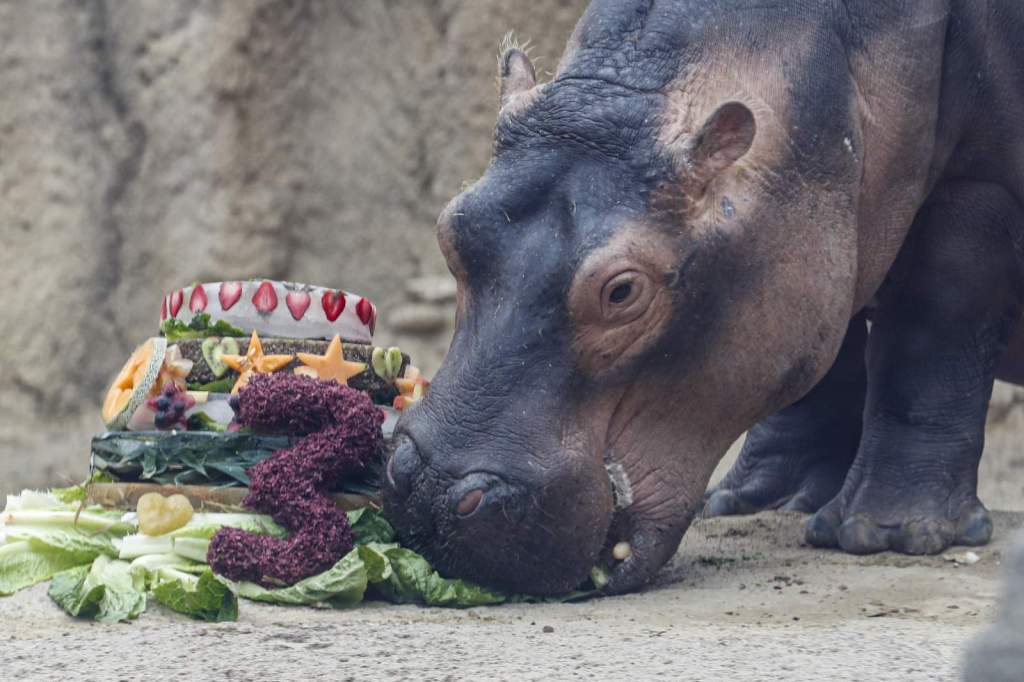
Fiona Cam
Fiona live video feed https://www.facebook.com/cincinnatizoo/photos/a.96076385478/10158043842200479/?type=3&theater
The Cincinnati Zoo & Botanical Garden Video Playlists https://www.youtube.com/user/CincinnatiZooTube/playlists
See what it’s like going no-cage diving with a school of Great White Sharks

Georgia Aquarium

Georgia Aquarium: Have a soothing look under the Sea with live cams of Beluga whales, African Penguins, Jellyfish and more.
Georgia Aquarium Video Playlists https://www.youtube.com/user/GeorgiaAquarium/playlists
Learn from the Georgia Aquarium https://www.georgiaaquarium.org/at-home-learning-with-georgia-aquarium/
Live Cams

Beluga live cam https://www.georgiaaquarium.org/webcam/beluga-whale-webcam/
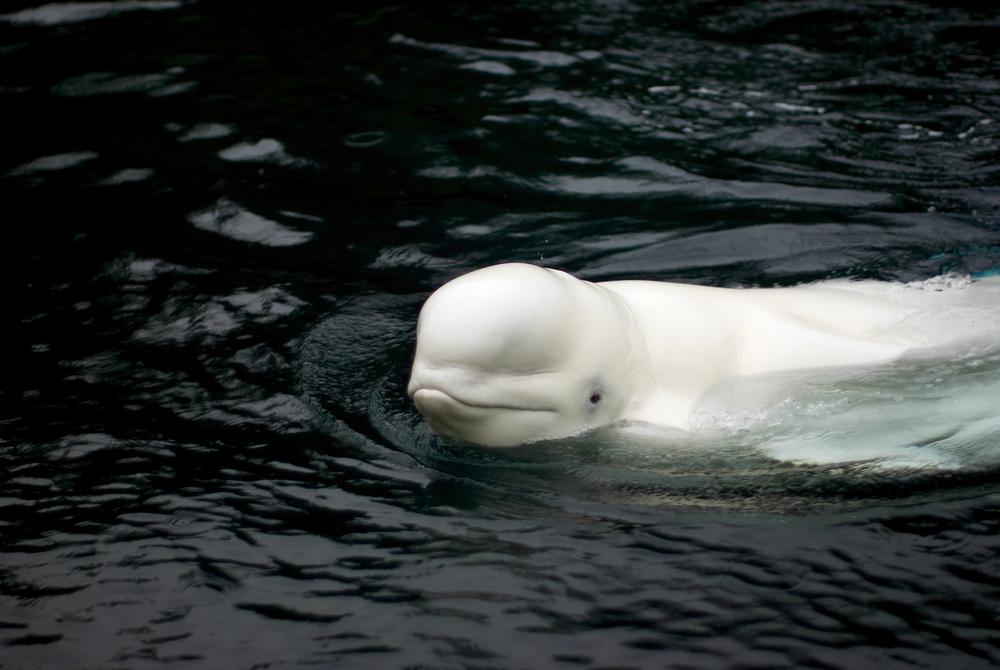
Beluga whales are small, white whales that live in the cold waters throughout the Arctic and some subarctic locations. They can be found in a variety of habitats, from deep offshore to shallow bays. Some even swim far up rivers. Belugas are social, and form groups called pods.(Georgia Aquarium) https://www.georgiaaquarium.org/animal/beluga-whale/
Fun Facts About Beluga Whales
1. Beluga whales grow up to 16 feet (4.8 m) long and weigh 3,150 pounds (1.4 metric tons) on average.
2. Beluga whales can live up to 50 years.
3. Beluga whales are born dark gray and get lighter as they age, eventually becoming white once they’ve reached sexual maturity.
4. Beluga whales can dive more than 3,280 feet (1,000 m) and stay under for up to 25 minutes at a time.
5. Beluga whales live in Arctic waters and sometimes venture into freshwater rivers.
6. Beluga whales shed their skin each summer by rubbing against coarse gravel.
7. Beluga whales do not have fused neck vertebrae like other whales, which allows them to move their heads up, down and side to side.
8. Beluga whales have bulbous, flexible foreheads called “melons” that help them produce sound and make facial expressions.
9. Beluga whales are often called the “canaries of the sea” because they vocalize many different sounds, including clicks, whistles, chirps and squeals. (Oceana) https://oceana.org/marine-life/marine-mammals/beluga-whale

Jelly Fish
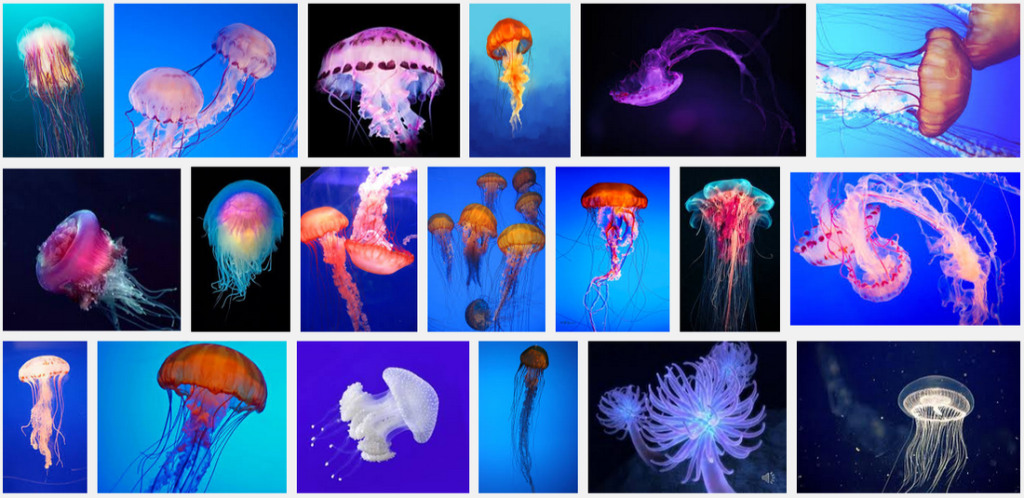
Jellyfish, any planktonic marine member of the class Scyphozoa (phylum Cnidaria), a group of invertebrate animals composed of about 200 described species, or of the class Cubozoa (approximately 20 species). The term is also frequently applied to certain other cnidarians (such as members of the class Hydrozoa) that have a medusoid (bell- or saucer-shaped) body form, as, for example, the hydromedusae and the siphonophores (including the Portuguese man-of-war). Unrelated forms such as comb jellies (phylum Ctenophora) and salps (phylum Chordata) are also referred to as jellyfish. Scyphozoan jellyfish can be divided into two types, those that are free-swimming medusae and those that are sessile (i.e., stem animals that are attached to seaweed and other objects by a stalk). The sessile polyplike forms constitute the order Stauromedusae. (Britannica) https://www.britannica.com/animal/jellyfish
There are 2,000 different types of Jellyfish. (Fact Retriever) https://www.factretriever.com/jellyfish-facts
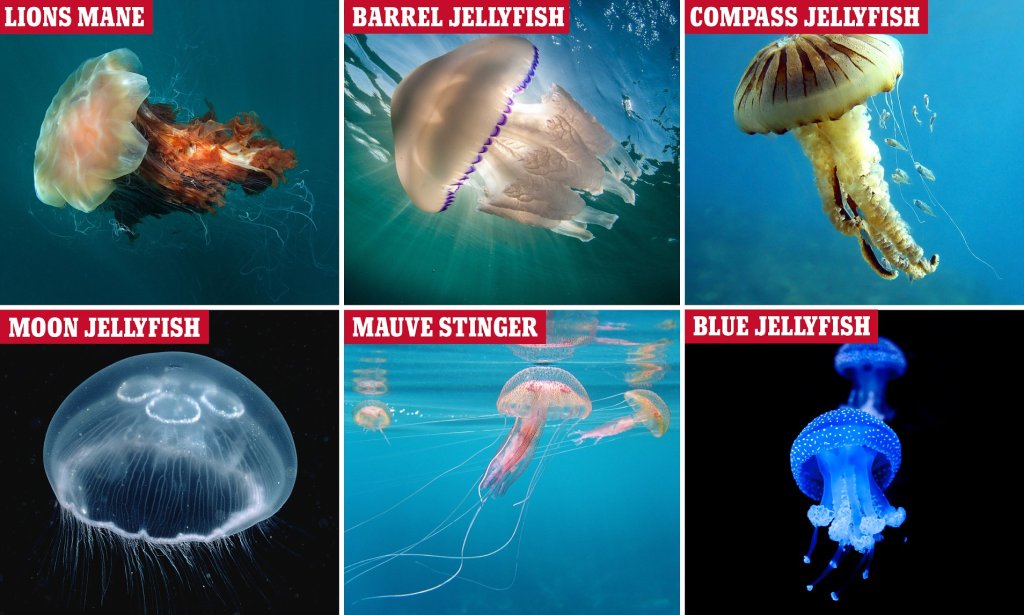
10 extraordinary jellyfish species https://www.mnn.com/earth-matters/animals/stories/extraordinary-jellyfish-species
Jelly Fish Live Cam
Georgia Aquarium Live Jellyfish Camera feed https://www.georgiaaquarium.org/webcam/jelly-webcam/
Ocean Voyager Live Cam
Georgia Aquarium Ocean Voyager Live camera Feed https://www.georgiaaquarium.org/webcam/ocean-voyager/

Sea Lions
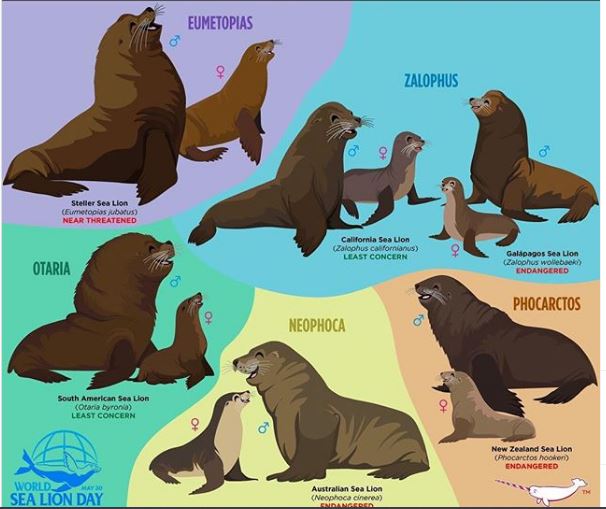
There are seven known Sea Lion species that have been identified.
Sea Lion Species
- California Sea Lion
- Steller Sea Lion
- Australian Sea Lion
- Galapagos Sea Lion
- New Zealand Sea Lion
- South American Sea Lion
- Japanese Sea Lion
California Sea Lions
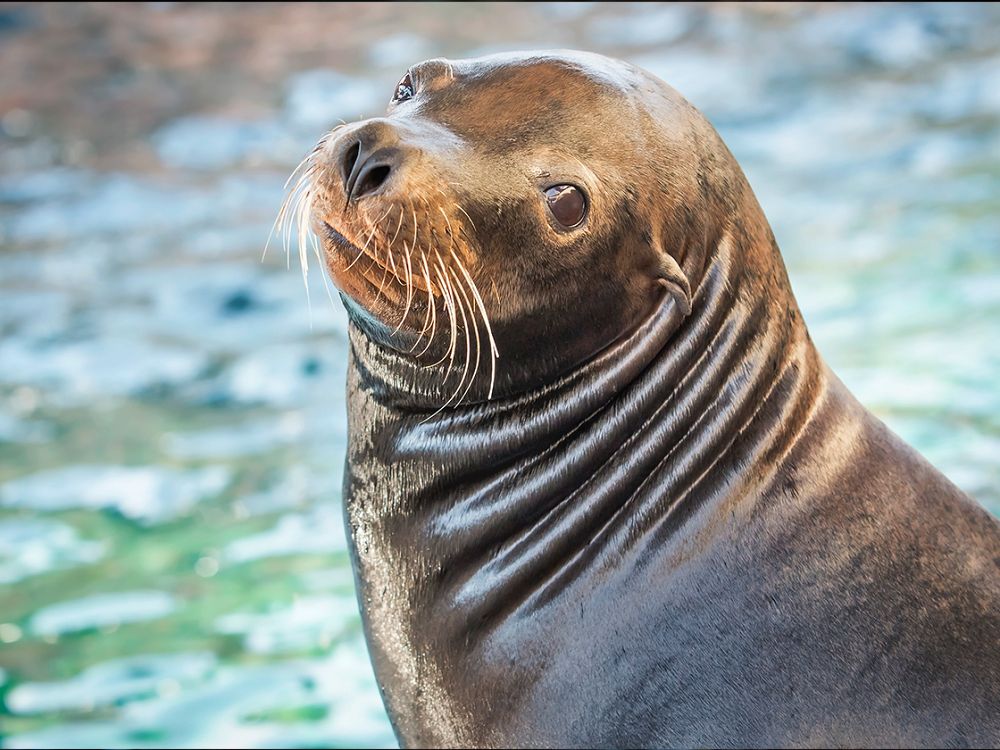
California sea lions are “eared seals” native to the West Coast of North America. They live in coastal waters and on beaches, docks, buoys, and jetties. They are easily trained and intelligent and are commonly seen in zoos and aquariums. California sea lions are playful, intelligent, and very vocal (sounding like barking dogs). (Fisheries NOAA) https://www.fisheries.noaa.gov/species/california-sea-lion
Stellar Sea Lion
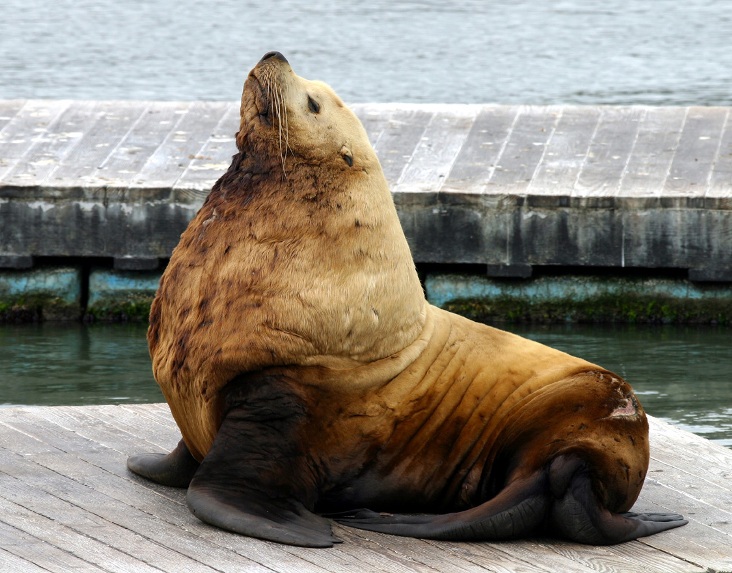
The Steller (or northern) sea lion is the largest member of the family Otariidae, the “eared seals,” which includes all sea lions and fur seals. Steller sea lions are named for Georg Wilhelm Steller, the German surgeon and naturalist on the Bering expedition who first described and wrote about the species in 1742. While they are the only living member of their genus, they share parts of their range with a smaller related species, California sea lions. Steller sea lions’ impressive low-frequency vocalizations sound more like roars than California sea lions’ barks. They also share parts of their range with another otariid: northern fur seal. (Fisheries NOAA) https://www.fisheries.noaa.gov/species/steller-sea-lion
Australian Sea Lion
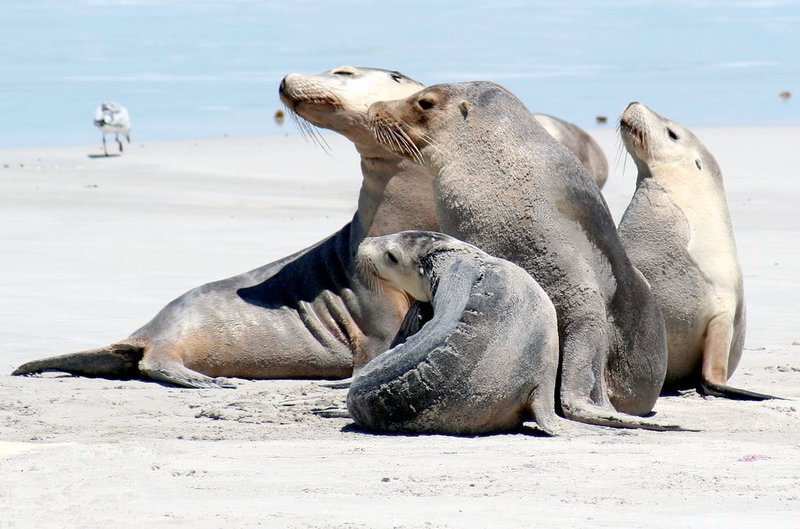
Quick Facts about Australian Sea Lions
- Sea lions typically live for 8 to 9 years
- Breeding cycles happen only once every 18 months and female will only breed at the site where they were born
- Breeding colonies are located only on remote areas of the coastline or islands and only 66 breeding colonies are known
- Estimated known population of sea lions is between 9900 to 12,500
- Population numbers are not growing and Australia sea lions are not expanding their range of colonies
- Typically fewer than 25 sea lion pups are produced annually and this number continues to decline
- Each sea lion colony is genetically distinct from neighbouring colonies and other populations
- The death of even a single female can have a negative impact on a colony’s survival, especially if the colony has a very low population. (Marine Conservation ) https://www.marineconservation.org.au/australian-sea-lions/
Galapagos Sea Lions
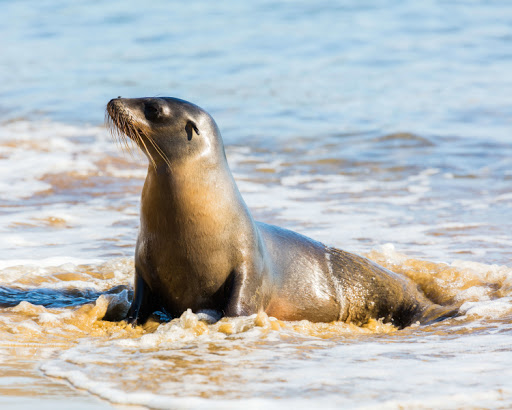
The Galapagos sea lion is a species that primarily breeds in the Galapagos Islands, although some breeding colonies also occur on Isla de la Plata just off of mainland Ecuador. They are one of two types of seal found in Galapagos and are part of the eared seal family – having external ear pinnae. They are not ‘true’ seals, as they are able to rotate their hind flipper under their pelvic girdle and lack the characteristic long, finger-like claws of true seals. The configuration of their pelvic girdle allows them to ‘gallop’ across land, reaching speeds exceeding that of a running person on rocky terrain. (Galapagos Conservation) https://galapagosconservation.org.uk/wildlife/galapagos-sea-lion/
New Zealand Sea Lions
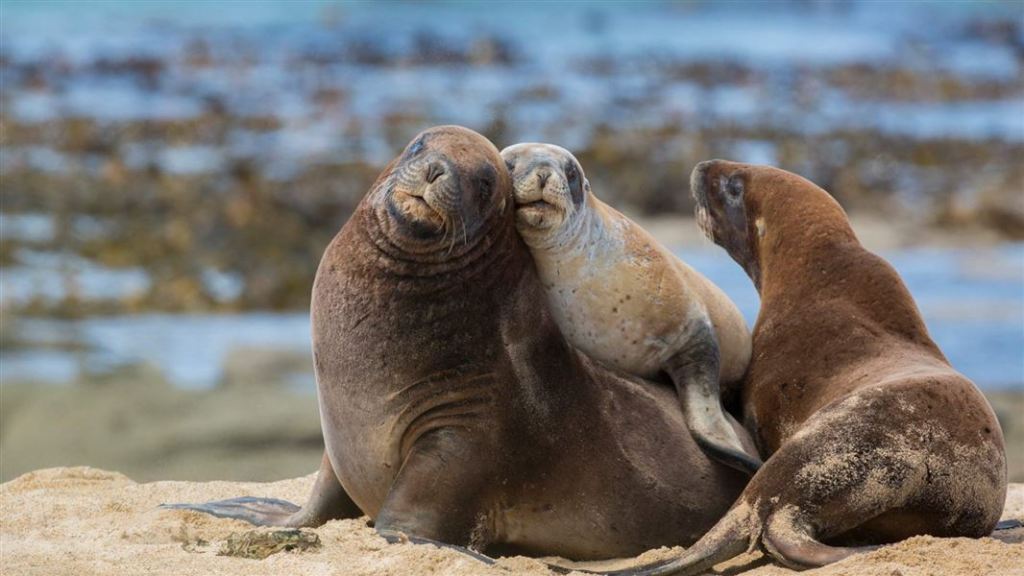
The New Zealand sea lion (Phocarctos hookeri) is distinguished from other New Zealand otariids by their blunt nose and short whiskers. They have sexual dimorphism, ie males and females are physically different.
Adult females (rāpoko):
- length 180–200 cm
- weight 85–160 kg
lighter in colour, predominantly creamy grey with darker pigmentation around their flippers.
The age of maturity for females is 3–4 years and the gestation period around 10 months. The average estimated reproductive rate of adult female New Zealand sea lions is 65% per year.
Adult males (whakahao):
- length 240–350 cm
- weight 320–450 kg
brown to black in colour with well-developed manes reaching to the shoulders.
Males are sexually mature when 5 years old, but they can’t sire their first pup until they are strong enough to hold their own territory, at about 8-9 years old.
Pups:
- length: approximately 70–100 cm
- weight: 8–10 kg.
both sexes are dark brown with paler areas around the head. Juvenile males can resemble adult females in colour and size.
Their maximum lifespan is 23 years. (Department of Conservation Te Papa Atawbai) https://www.doc.govt.nz/nature/native-animals/marine-mammals/seals/new-zealand-sea-lion/species/biology/
South American Sea Lion
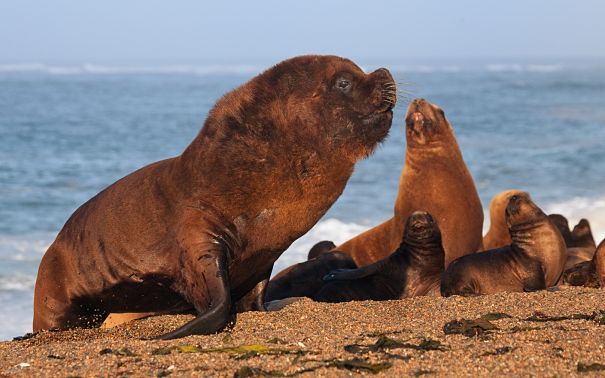
Amongst pinnipeds, the winged-footed family, there are eared seals and true seals. The former are also known as fur seals and sea lions. The South American sea lion’s technical name is the Patagonian sea lion but this name is rarely used. When full grown the male sea lions are twice the weight of females and around their large heads is a patch of short hair similar to the beginnings of a lion’s mane. Males have a neck that is more muscled than that of females. ( Animalia) http://animalia.bio/south-american-sea-lion
Sea Lion web cam
Georgia Aquarium Sea Lion Live camera feed https://www.georgiaaquarium.org/webcam/california-sea-lion-cam/
Indo Pacific Cam https://www.georgiaaquarium.org/webcam/indo-pacific-barrier-reef/

Alligators
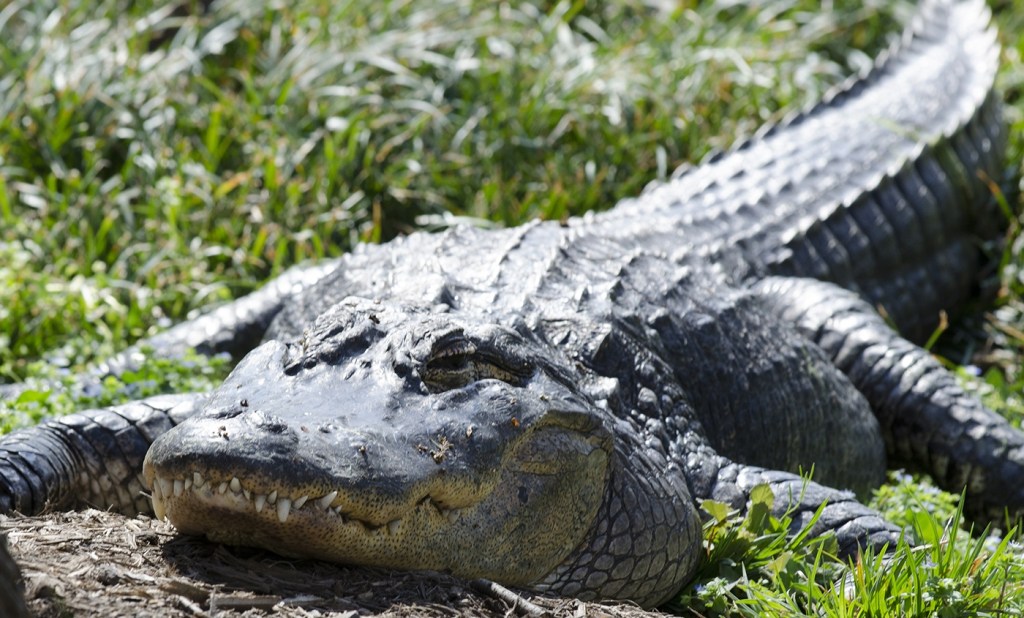
An alligator is a crocodilian in the genus Alligator of the family Alligatoridae. The two living species are the American alligator (A. mississippiensis) and the Chinese alligator (A. sinensis). Additionally, several extinct species of alligator are known from fossil remains. Alligators first appeared during the Oligocene epoch about 37 million years ago. (Wikipedia) https://en.wikipedia.org/wiki/Alligator
Both males and females have an “armored” body with a muscular, flat tail. The skin on their back is armored with embedded bony plates called osteoderms or scutes. They have four short legs; the front legs have five toes while the back legs have only four toes. Alligators have a long, rounded snout that has upward facing nostrils at the end; this allows breathing to occur while the rest of the body is underwater. The young have bright yellow stripes on the tail; adults have dark stripes on the tail. (Smithsonian National Zoo) https://nationalzoo.si.edu/animals/american-alligator
Chinese Alligator
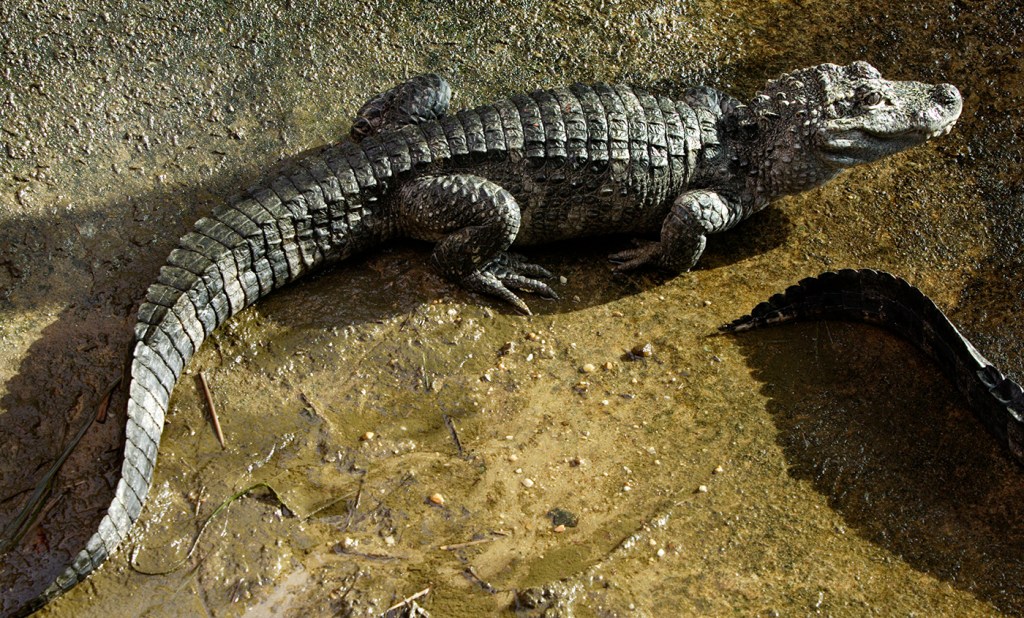
The critically endangered Chinese alligator differs from its American counterpart in subtle ways. It’s smaller, the head is more robust and its snout is slightly upturned. The eyelids of the Chinese alligator have a bony plate that is missing in the American alligator. The American alligator also lacks the bony belly plates, or osteoderms, of the Chinese alligator. (Smithsonian National Zoo) https://nationalzoo.si.edu/animals/chinese-alligator
11 Amazing Facts About Alligators https://www.mentalfloss.com/article/56093/11-terrifying-and-amazing-facts-about-alligators
Gator crossing Live Feed video from Georgia Aquarium https://www.georgiaaquarium.org/webcam/gator-crossing/

Southern Sea Otters
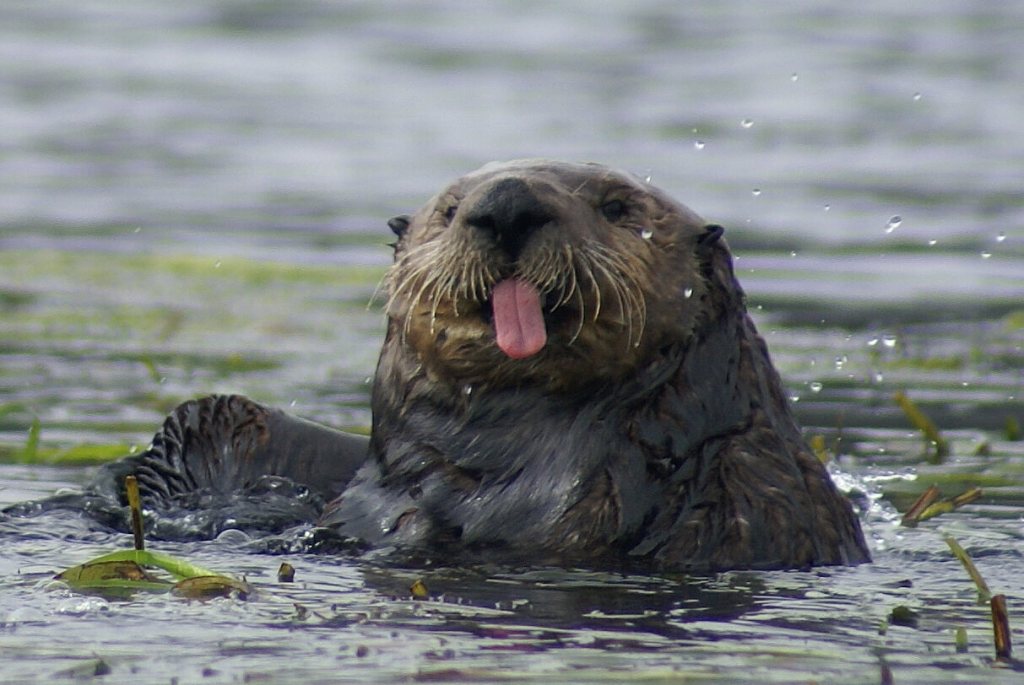
Sea otters have a narrow skull with a wide rostrum and long nasal bones. They have pronounced canine teeth. Their facial vibrissae (whiskers) may reach 10.2 cm (4 in) in length but are usually worn down to about 5 cm (2 in). Their dexterous front paws have retractile claws while the claws on their flat, webbed hind feet that act as flippers do not retract. They have a flat, blunt tail that can be about one-fourth their total body length.
An otter’s dense fur can be brown, black, blonde, and even silver in coloration and facial hair may turn white with age. (Aquarium of Pacific)https://www.aquariumofpacific.org/onlinelearningcenter/species/southern_sea_otter
Sea Otter live video from Georgia Aquarium https://www.georgiaaquarium.org/webcam/southern-sea-otter-webcam/
To learn more about Southern Sea Otters, click this link https://www.montereybayaquarium.org/animals/animals-a-to-z/sea-otter

African Penguins
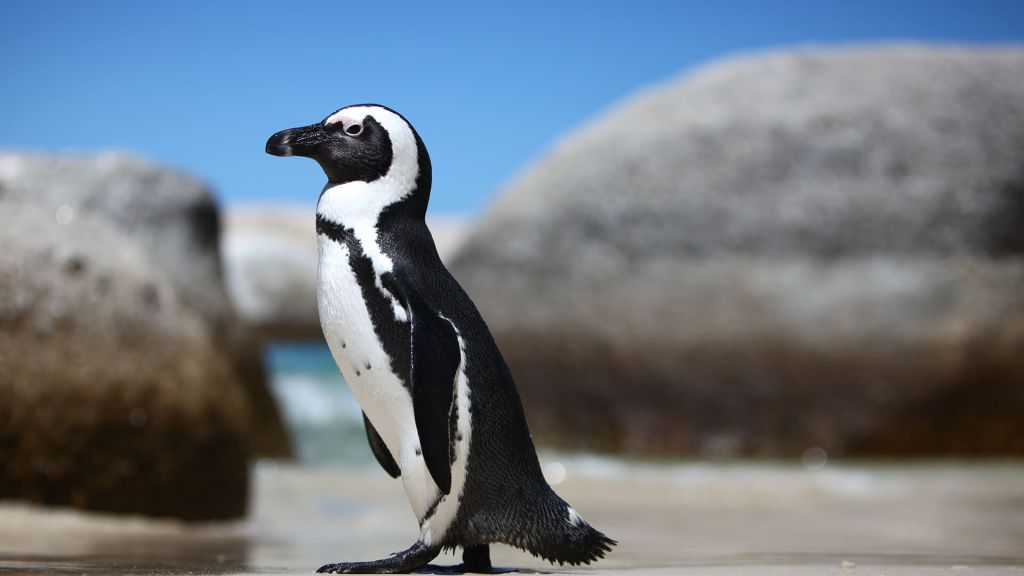
While the African penguin may not be found in freezing temperatures, they are covered in an array of black, white, and gray dense, waterproof feathers that keep them dry and warm in the cold waters off the African coast. They also have a number of dot-like markings flecked across their white chests. These flecks help to individualize each penguin, as each penguin’s feather pattern is as individual as a human’s fingerprints. The animal has a distinct, sharply pointed beak and black feet. The African penguin is one of the smallest species. Males are generally slightly larger than their female counterparts. (San Diego Zoo) https://animals.sandiegozoo.org/animals/african-penguin
African Penguins live video feed from Georgia Aquarium https://www.georgiaaquarium.org/webcam/african-penguin-cam/

Puffin
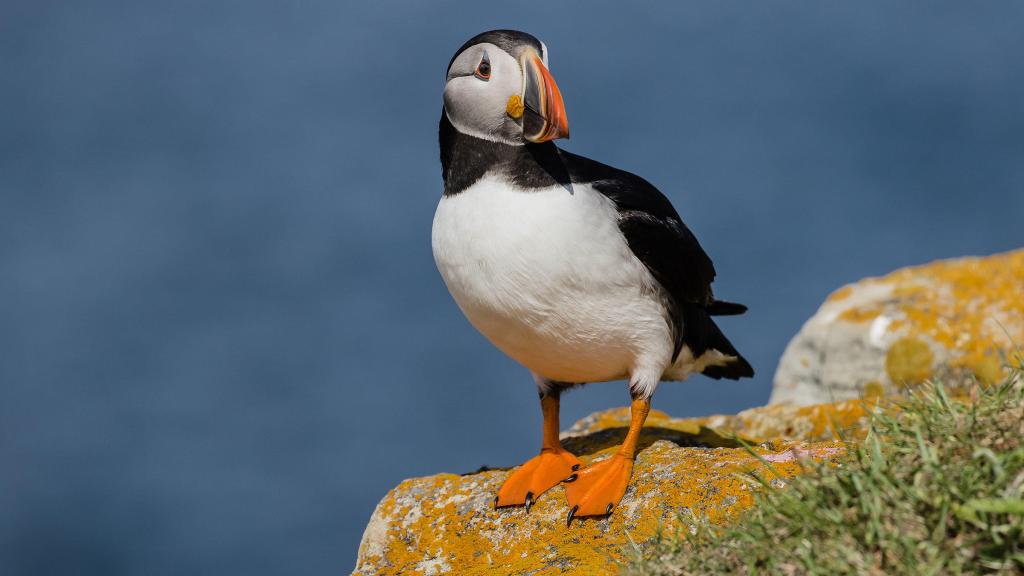
A sharply dressed black-and-white seabird with a huge, multicolored bill, the Atlantic Puffin is often called the clown of the sea. It breeds in burrows on islands in the North Atlantic, and winters at sea. In flight, puffins flap their small wings frantically to stay aloft—but underwater those wings become powerful flippers that allow the birds to catch small fish one by one until they have a beak full. This long-lived bird, once widely hunted, is reestablishing its small range in the U.S., although warming ocean waters are causing breeding failures in other parts of the North Atlantic. (All about Birds) https://www.allaboutbirds.org/guide/Atlantic_Puffin/overview
Learn more about Puffins, please follow this link https://www.nationalgeographic.com/animals/birds/a/atlantic-puffin/
Under water Puffin Cam https://www.georgiaaquarium.org/webcam/puffin-cam/
Georgia Aquarium Web cams main page
Live video’s https://www.georgiaaquarium.org/webcam/ocean-voyager/

Houston Zoo

This Texas zoo has webcams focused on gorillas, giraffes, rhinos, elephants, leafcutter ants and more for your viewing pleasure.
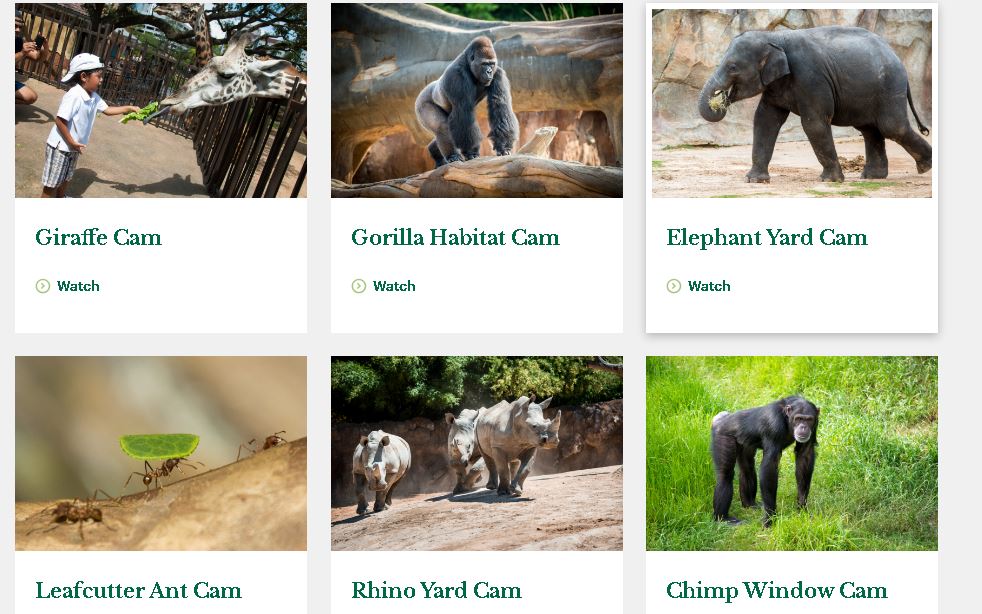
Houston Zoo webcams https://www.houstonzoo.org/explore/webcams/
Houston Zoo Video Playlists https://www.youtube.com/user/houstonzoo/playlists

Loggerhead Marine life Center

While the Florida marine center is closed to the public, they’re continuing to take care of their sea turtle patients behind the scenes. Monday through Friday they will be streaming live from the sea turtle hospital and teaching viewers about ocean conservation. https://marinelife.org/homelearn/
Loggerhead Marine life Center Video Playlists https://www.youtube.com/user/loggerheadmc/playlists

Sea Turtles
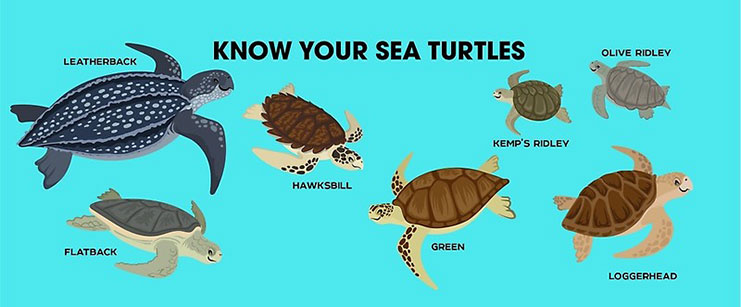
Leatherback Turtle
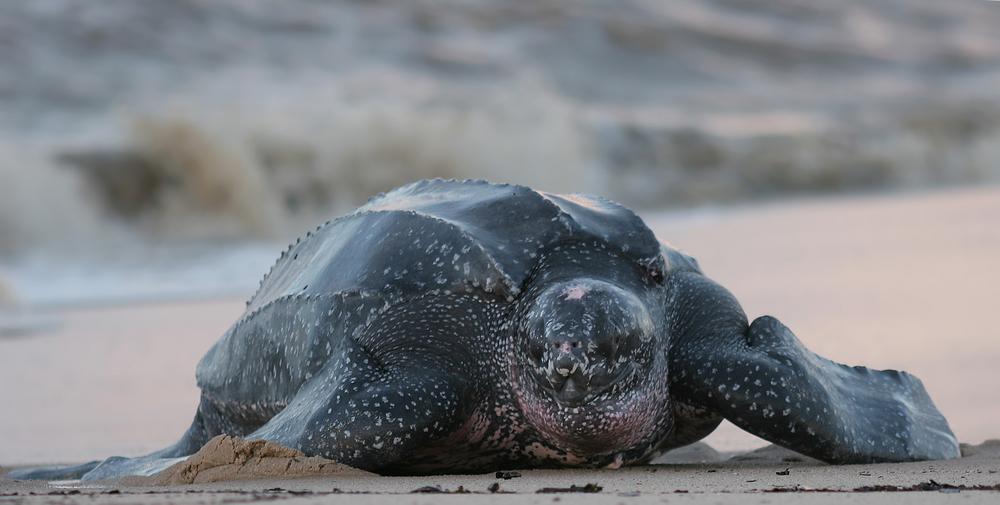
- Named for smooth, rubbery shell
- Feed on jellyfish
- Weigh 700 – 1500 pounds and are 4 – 8 feet in length
- Nest in Florida March – July
Leatherback turtles are named for their shell, which is leather-like rather than hard, like other turtles.
They are the largest sea turtle species and also one of the most migratory, crossing both the Atlantic and Pacific Oceans. Pacific leatherbacks migrate from nesting beaches in the Coral Triangle all the way to the California coast to feed on the abundant jellyfish every summer and fall.
Although their distribution is wide, numbers of leatherback turtles have seriously declined during the last century as a result of intense egg collection and fisheries bycatch. Globally, leatherback status according to IUCN is listed as Vulnerable, but many subpopulations (such as in the Pacific and Southwest Atlantic) are Critically Endangered. (WWF) https://www.worldwildlife.org/species/leatherback-turtle
Loggerhead
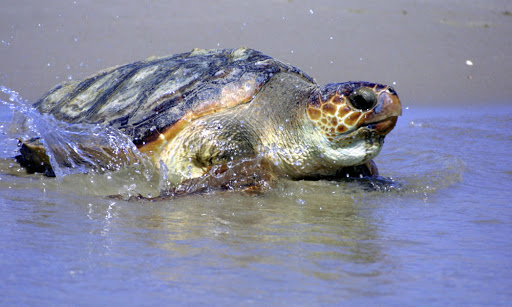
- Named for large head
- Feed on crabs, mollusks, encrusting animals attached to reefs and rocks
- Weigh 200 – 400 pounds and are approximately 3 feet
- Nest in Florida April – Sept
Loggerhead turtles are named for their large heads that support powerful jaw muscles, allowing them to crush hard-shelled prey like clams and sea urchins. They are less likely to be hunted for their meat or shell compared to other sea turtles. Bycatch, the accidental capture of marine animals in fishing gear, is a serious problem for loggerhead turtles because they frequently come in contact with fisheries.
Loggerheads are the most common turtle in the Mediterranean, nesting on beaches from Greece and Turkey to Israel and Libya. Many of their nesting beaches are under threat from tourism development. Sea turtles are the living representatives of a group of reptiles that has existed on Earth and travelled our seas for the last 100 million years. They are a fundamental link in marine ecosystems and help maintain the health of coral reefs and sea grass beds. (WWF) https://www.worldwildlife.org/species/loggerhead-turtle
Green Sea Turtle
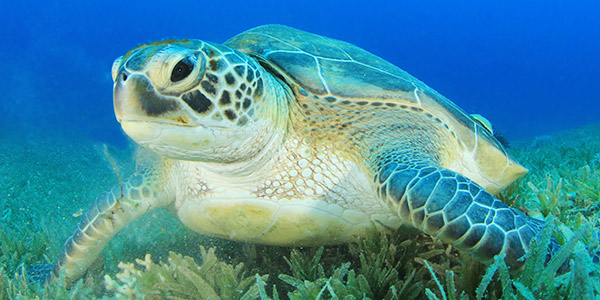
- Named for greenish color of body fat
- Feeds on seagrass & seaweed
- Females weigh up to 600 pounds and are 3 – 4 feet in length
- Nest in Florida May – September
The green turtle is one of the largest sea turtles and the only herbivore among the different species. Green turtles are in fact named for the greenish color of their cartilage and fat, not their shells. In the Eastern Pacific, a group of green turtles that have darker shells are called black turtles by the local community. Green turtles are found mainly in tropical and subtropical waters. Like other sea turtles, they migrate long distances between feeding grounds and the beaches from where they hatched. Classified as endangered, green turtles are threatened by overharvesting of their eggs, hunting of adults, being caught in fishing gear and loss of nesting beach sites. (WWF) https://www.worldwildlife.org/species/green-turtle
Hawksbill
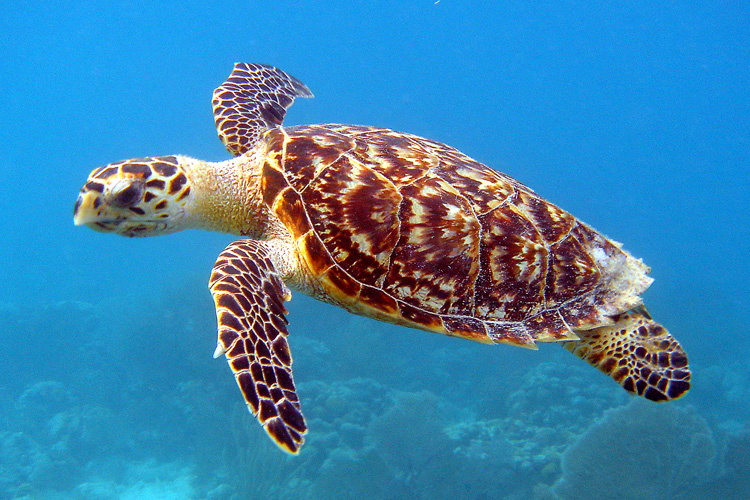
Hawksbill
- Named for hawk-like beak
- Feed on sponges
- Weigh 100 – 150 pounds and are 25 – 35 inches in length
- Very few, if any, nest in Palm Beach County
- Primary nesting beaches in the Caribbean, very few, if any, nest in Palm Beach County
Hawksbills are named for their narrow, pointed beak. They also have a distinctive pattern of overlapping scales on their shells that form a serrated-look on the edges. These colored and patterned shells make them highly-valuable and commonly sold as “tortoiseshell” in markets.
Hawksbills are found mainly throughout the world’s tropical oceans, predominantly in coral reefs. They feed mainly on sponges by using their narrow pointed beaks to extract them from crevices on the reef, but also eat sea anemones and jellyfish. Sea turtles are the living representatives of a group of reptiles that has existed on Earth and travelled our seas for the last 100 million years. They are a fundamental link in marine ecosystems and help maintain the health of coral reefs and sea grass beds. (WWF) https://www.worldwildlife.org/species/hawksbill-turtle

Monterey Bay Aquarium
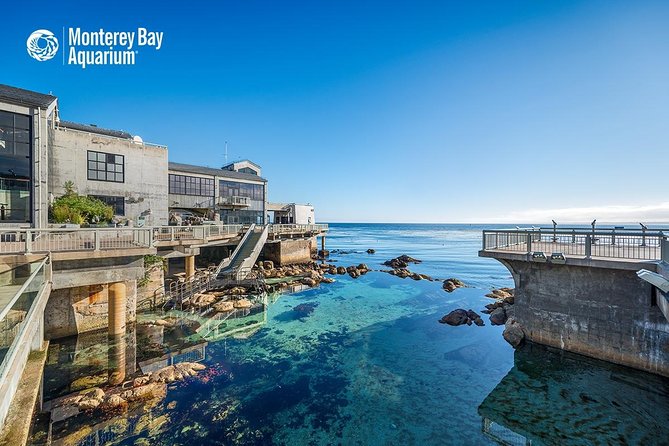
Monterey Bay Aquarium: Dive under water with livestreams of sharks, sea otters, jellyfish, and turtles. A live cam of the crashing waves in the Monterey Bay itself is particularly calming. https://www.montereybayaquarium.org/animals/live-cams
Monterey Bay Aquarium Video Playlists https://www.youtube.com/user/MontereyBayAquarium/playlists

National Aquarium

National Aquarium: Explore winding, sea life-filled floors with this virtual tour of the Baltimore-based aquarium. https://aqua.org/media/virtualtours/baltimore/index.html
At Home Activities https://www.aqua.org/activities
National Aquarium Video Playlists https://www.youtube.com/user/nataquarium/playlists

New England Aquarium

New England Aquarium: This Boston-based aquarium is serving up a schedule of animal feedings, tours and behind-the-scenes content on their Facebook Live https://www.facebook.com/pg/NewEnglandAquarium/posts/?ref=page_internal
Learn with the Aquarium https://www.neaq.org/learn/
New England Aquarium Video Playlists https://www.youtube.com/user/NewEnglandAquarium/playlists

Ocean Ramsey IGTV

Ocean Ramsey IGTV: Often described as a “sharfluencer,” this diving expert swam with one of the largest Great Whites ever recorded. Now, she’s sharing her adventures on her IGTV channel. https://www.instagram.com/oceanramsey/channel/?hl=en

Oregon zoo

Oregon Zoo: This zoo is sharing daily video updates on their Facebook page of different animals during their temporary closure. https://www.facebook.com/pg/oregonzoo/videos/
Oregon Zoo Video Playlists https://www.youtube.com/user/oregonzoo/playlists

San Diego Zoo
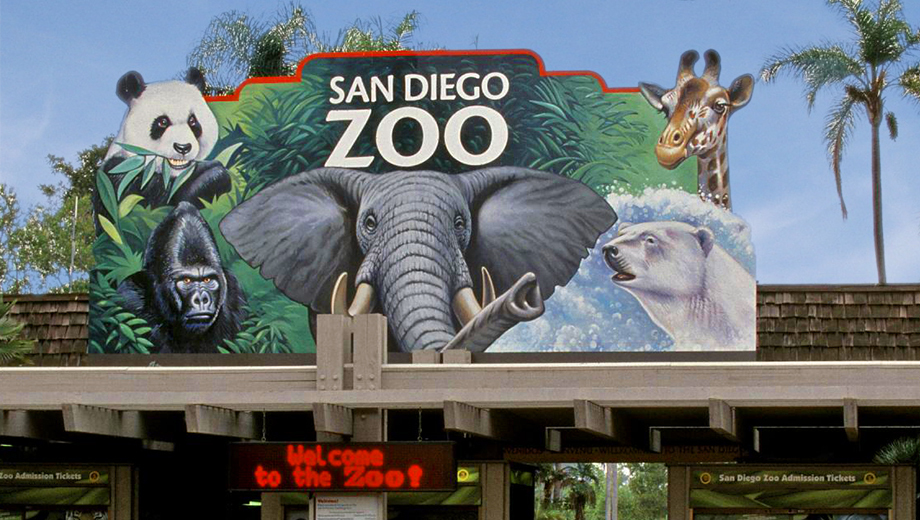
San Diego Zoo: This zoo has a number of different live cams monitoring their furry and feathered friends, including penguins, pandas, koalas and elephants. https://kids.sandiegozoo.org/videos
Learn more about the Animals and Plants at the Zoo https://zoo.sandiegozoo.org/animals-plants
San Diego Zoo Video Playlist https://www.youtube.com/user/SDZoo/playlists

The Secret Life of the Zoo
71 videos https://www.youtube.com/playlist?list=PLezFqA7wz0TEG1-JNMeFahoQRxmhfWsS1

Wildlife at the Zoo
Wildlife at the Zoo Youtube Channel Playlists https://www.youtube.com/channel/UCX4ObI81exAqEYkXiWXcVgA/videos

The Butchart Gardens

Dubai Miracle Garden

Every year from mid-November to mid-May, a 72,000 sqm space full of scents and colours comes to life. This incredible experience is one of Cityland’s signature creations – Dubai Miracle Garden. It was launched on Valentine’s Day, 2013, and is set in the heart of Dubailand.
Seeing the garden in full bloom with its 150 million flowers arranged in colourful arches and patterns, and the myriad shapes they form, is truly magnificent. https://www.dubaimiraclegarden.com/
Dubai Miracle Garden Pictures
Dubai Miracle Garden 2020 (Day Tour)

Exbury Gardens – England

Exbury Gardens – England
Exbury Gardens Steam Railway 21/4/19
Exbury Gardens Steam Railway Diver’s Eye View
Great Gardens of England
Colorful Woodland Garden, Berea, USA

Thanks for strolling through the Zoo’s , Aquariums, and Gardens with me today! I hope you enjoyed your visit. If you did like the post please feel free to; Like, Comment, Share, and Subscribe. I look forward to seeing you here again soon.

 Angelika's World