

Pluto Day
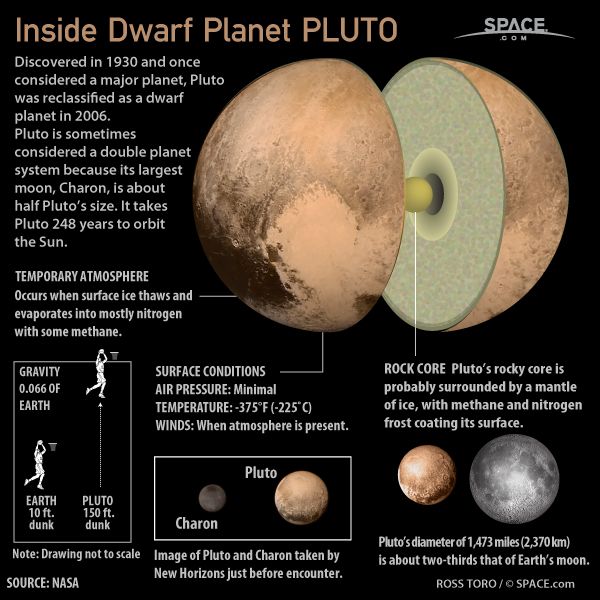
On this day February 18th in 1930, The planet Pluto was Discovered. US astronomer Clyde Tombaugh discovered Pluto while working at at Lowell Observatory in Arizona. Tombaugh used a one-of-a-kind telescope, nicknamed the “T4” in this planet discovery. Read on to learn more about this Great Astronomer and the Now categorized Dwarf Planet Pluto.
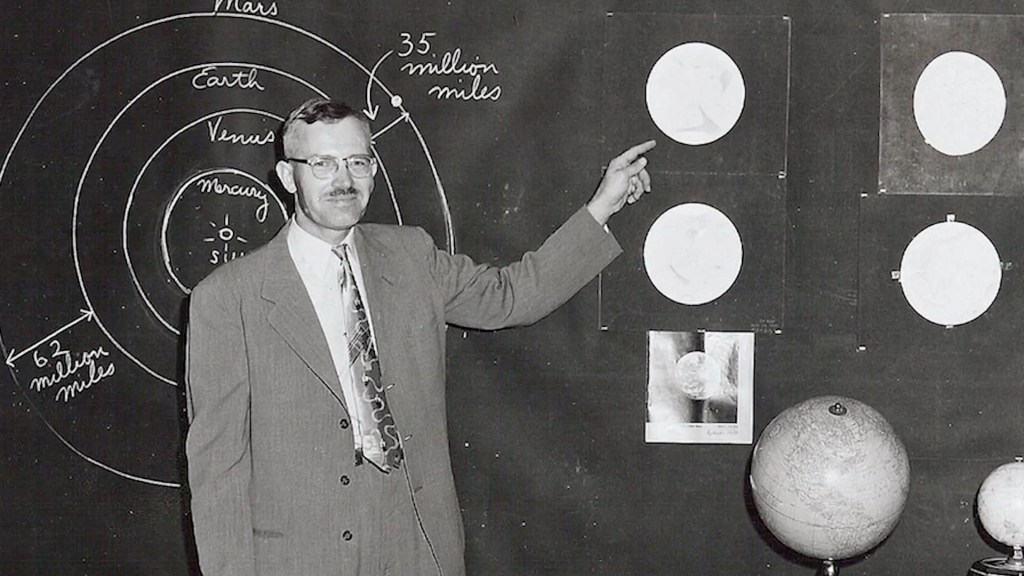
Facts about Clyde Tombaugh
In 1928, the amateur astronomer was offered a job at Lowell Observatory in Arizona, where he discovered Pluto.

To learn more about Lowell Observatory click this link https://lowell.edu/
Pluto was discovered in 1930 by Clyde Tombaugh.
In 1934, he married Patricia Edson. They had two children, Annette and Alden.
He earned his bachelor’s and master’s degree in astronomy from the University of Kansas, working at the observatory during the summers.

To Learn more about the University of Kansas, Click this link https://ku.edu/

Tombaugh remained at Lowell Observatory until the advent of World War II, when he was called into service teaching navigation to the U.S. Navy at Arizona State College.

To learn more about Arizona State College, click the link. https://www.asu.edu/
After the war concluded, he worked at the ballistics research laboratory at White Sands Missile Range in New Mexico.
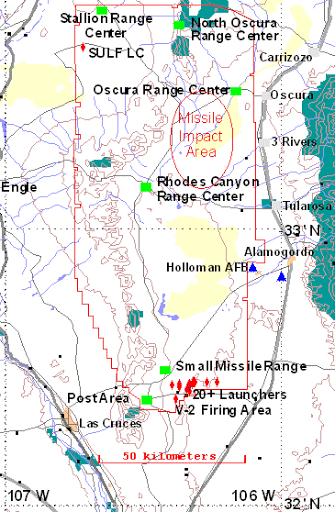
“A one-of-a-kind telescope, nicknamed the “T4,” that hasn’t been used since the 1960s will soon be on permanent display at the White Sands Missile Range Museum Missile Park.
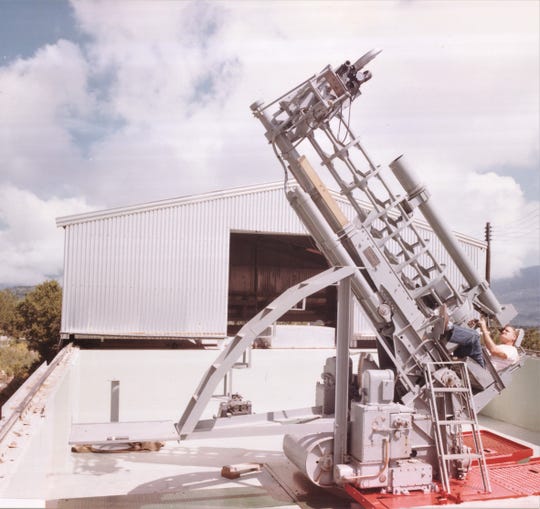
The telescope’s New Mexico journey begins in 1948 when a Telescope IV, commonly referred to as T-4, was shipped from the Ballistic Research Laboratory at Aberdeen Proving Grounds, Maryland, to Mule Peak located at about 7,000 feet and not too far from Alamogordo.
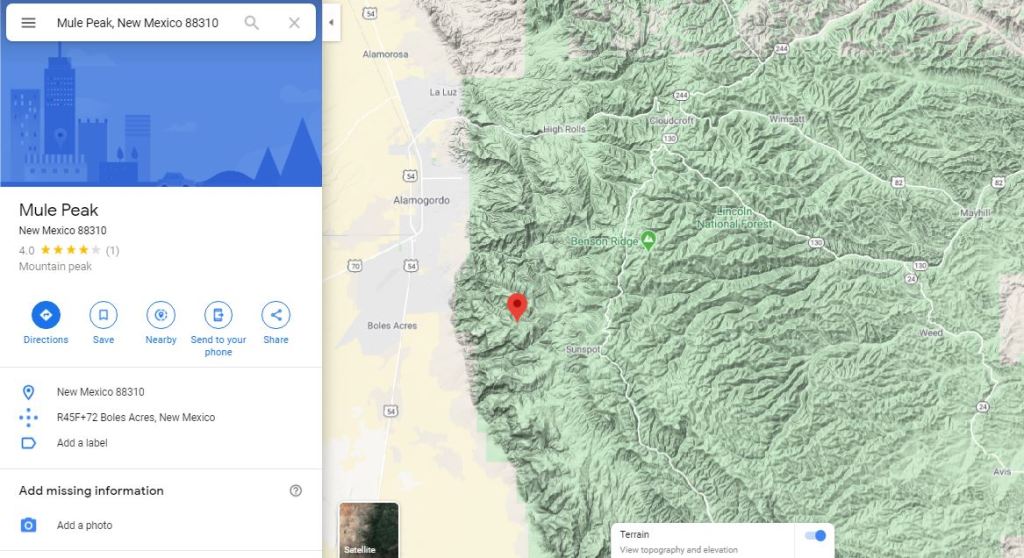
A year earlier, the U.S. Forest Service granted a special-use-permit to White Sands Providing Ground(AKA White Sands Missile Range), authorizing the Army to use Mule Peak for installing experimental instruments, as well as installing shelters and constructing an access road in support of obtaining ballistic measurements on guided missile testing.
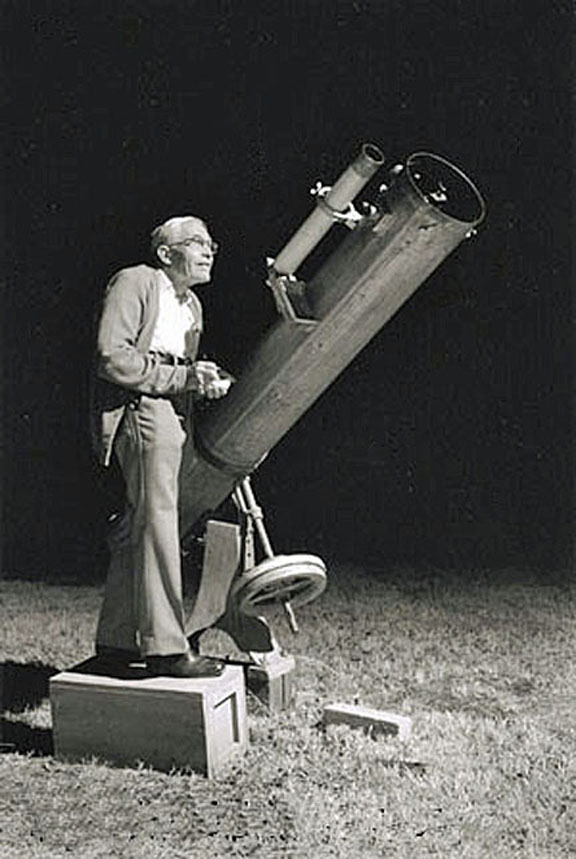
The T-4 — one of five newly developed tracking telescopes belonging to astronomer Clyde Tombaugh’s Optical Measurements Branch at WSMR — was used to track most missile tests fired from WSMR, beginning with the V-2 rocket.
The T-1 through T-4 telescopes were built upon air defense anti-aircraft gun mounts. The T-4 telescope uses a 90mm M2 gun mount, with the barrel of the gun still present, although capped. Only one of its kind was ever built.
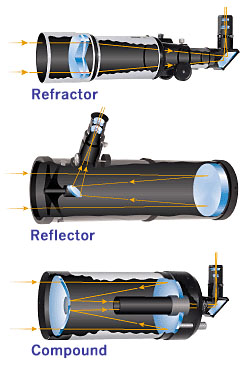
The three basic telescope designs use different optics to achieve the same result: making distant objects look bigger and brighter than they appear to your eye. See the text for links to animations that show how light passes through the optics of each design.
Refractors have a lens at the front of the tube — it’s the type you’re probably most familiar with. While generally low maintenance, they quickly get expensive as the aperture increases. In refractor lingo, an apochromat offers better optical quality (and is more expensive) than an achromat of the same size. Watch an animation of light passing through a refractor.
Reflectors gather light using a mirror at the rear of the main tube. For a given aperture, these are generally the least expensive type, but you’ll need to adjust the optical alignment every now and then — more often if you bump it around a lot — but that adjustment (called collimation) is straightforward. Watch an animation of light passing through a reflector.
Compound (or catadioptric) telescopes, which use a combination of lenses and mirrors, offer compact tubes and relatively light weight; two popular designs you’ll often see are called Schmidt-Cassegrains and Maksutov-Cassegrains.
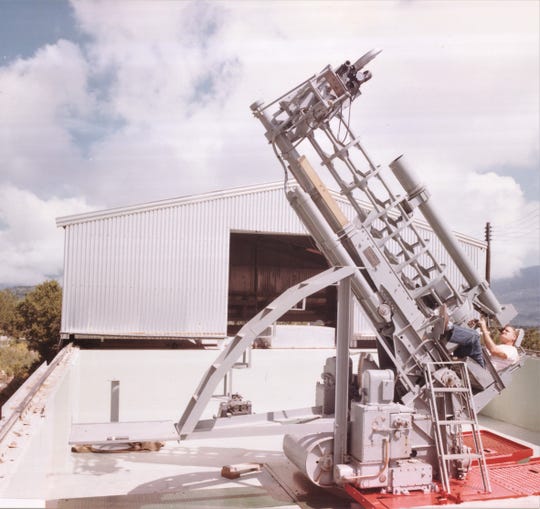
The T-4 telescope has not been used since the 1960s, although the crew shelter and other structures were utilized into the 1980s. Bill Godby, archaeologist with the Garrison Cultural Resources Program, spearheaded efforts to have the telescope removed and brought back to WSMR Museum as an outdoor display to be created recognizing Clyde Tombaugh and his efforts. Tombaugh worked at WSMR from 1946 to 1955, and also taught astronomy at New Mexico State University from 1955 until his retirement in 1973. He discovered Pluto in 1930, the first object to be discovered in what would later be identified as the Kuiper belt. In 1980 he was inducted into the International Space Hall of Fame”. (Las Cruces Sun News) https://www.lcsun-news.com/story/news/local/2019/07/06/historic-telescope-finds-new-home-white-sands-missile-range/1664798001/
From 1955 until he retired in 1973, he taught at New Mexico State University.
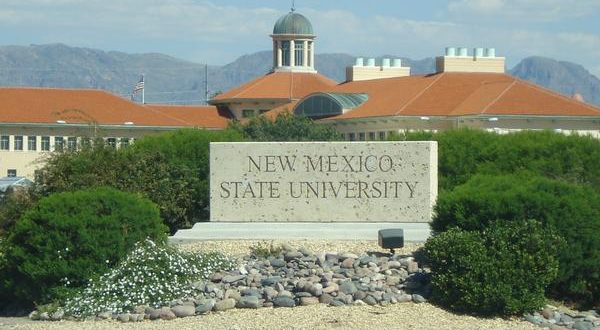
To learn more about New Mexico State University, click the link. https://www.nmsu.edu/
Tombaugh passed away at his home in Las Cruces, N.M., on Jan. 17, 1997.

Las Cruces NM
I lived in Las Cruces NM for 11 years. This is a unique City indeed. It is a Great Vacation place. https://www.lascrucescvb.org/
Pluto was named by Venetia Burney, an 11-year-old girl.

Venetia Burney, aged 11, around the time she named the dwarf planet Pluto Image via J. Weston & Son Photographers, Eastbourne, Brighton in England, UK/ Wikimedia Commons.
Pluto was named by Venetia Burney, an 11-year-old girl. https://earthsky.org/space/this-date-in-science-pluto-gets-its-name
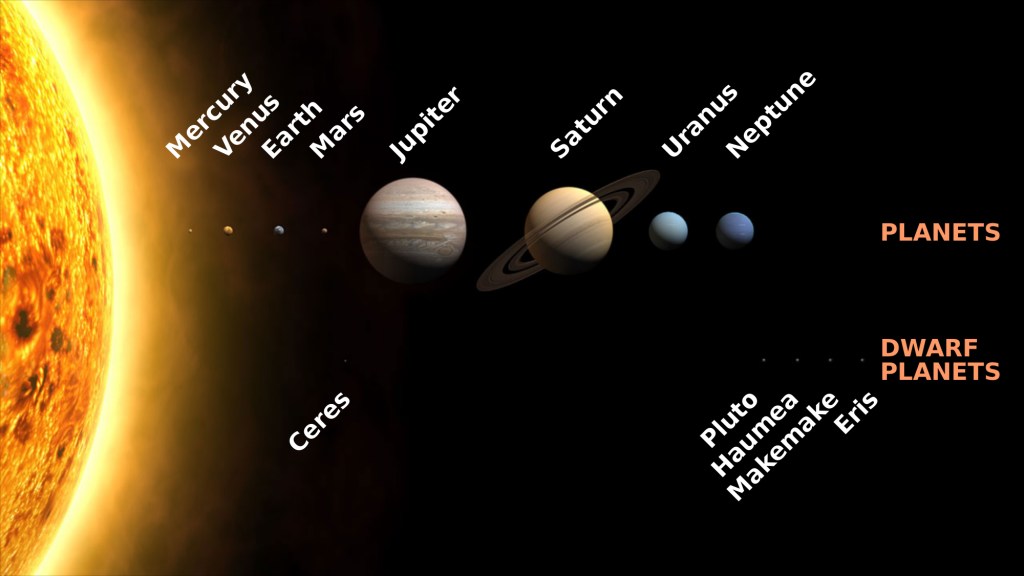
What Is a Planet?
This seemingly simple question doesn’t have a simple answer. Everyone knows that Earth, Mars and Jupiter are planets. But both Pluto and Ceres were once considered planets until new discoveries triggered scientific debate about how to best describe them—a vigorous debate that continues to this day. The most recent definition of a planet was adopted by the International Astronomical Union in 2006.
The New Definition of Planet
The IAU (International Astronomical Union) therefore resolves that planets and other bodies, except satellites, in our Solar System be defined into three distinct categories in the following way:
A planet is a celestial body that (a) is in orbit around the Sun, (b) has sufficient mass for its self-gravity to overcome rigid body forces so that it assumes a hydrostatic equilibrium (nearly round) shape, and (c) has cleared the neighbourhood around its orbit.
A “dwarf planet” is a celestial body that (a) is in orbit around the Sun, (b) has sufficient mass for its self-gravity to overcome rigid body forces so that it assumes a hydrostatic equilibrium (nearly round) shape, (c) has not cleared the neighbourhood around its orbit, and (d) is not a satellite.
All other objects,except satellites, orbiting the Sun shall be referred to collectively as “Small Solar System Bodies”. https://solarsystem.nasa.gov/planets/in-depth/
Just for Fun Videos that have Pluto
I hope you have enjoyed this Post about Pluto. I know that it was quiet Educational. I learned a lot that I hadn’t heard about the Dwarf Planet. If you liked this Post, please


 Angelika's World